Von der Molekularbiologie zur ästhetischen Medizin – eine kritische Einordnung!
Die neue Hoffnung der Ästhetik
Sie tragen edle Namen wie „PN-HPT™“, „Rejuran®“ oder schlicht „Salmon DNA“.
Die neueste Welle der ästhetischen Medizin verspricht natürliche Regeneration durch Polynucleotide – meist gewonnen aus Lachs-Sperma.
Was klingt wie ein kurioser Marketing-Gag, hat sich in vielen Praxen bereits als Standard etabliert.
Doch ist diese Therapieform tatsächlich ein biotechnologischer Durchbruch – oder nur ein weiteres Kapitel in der langen Geschichte kosmetischer Moden?
DNA ist nicht gleich Information
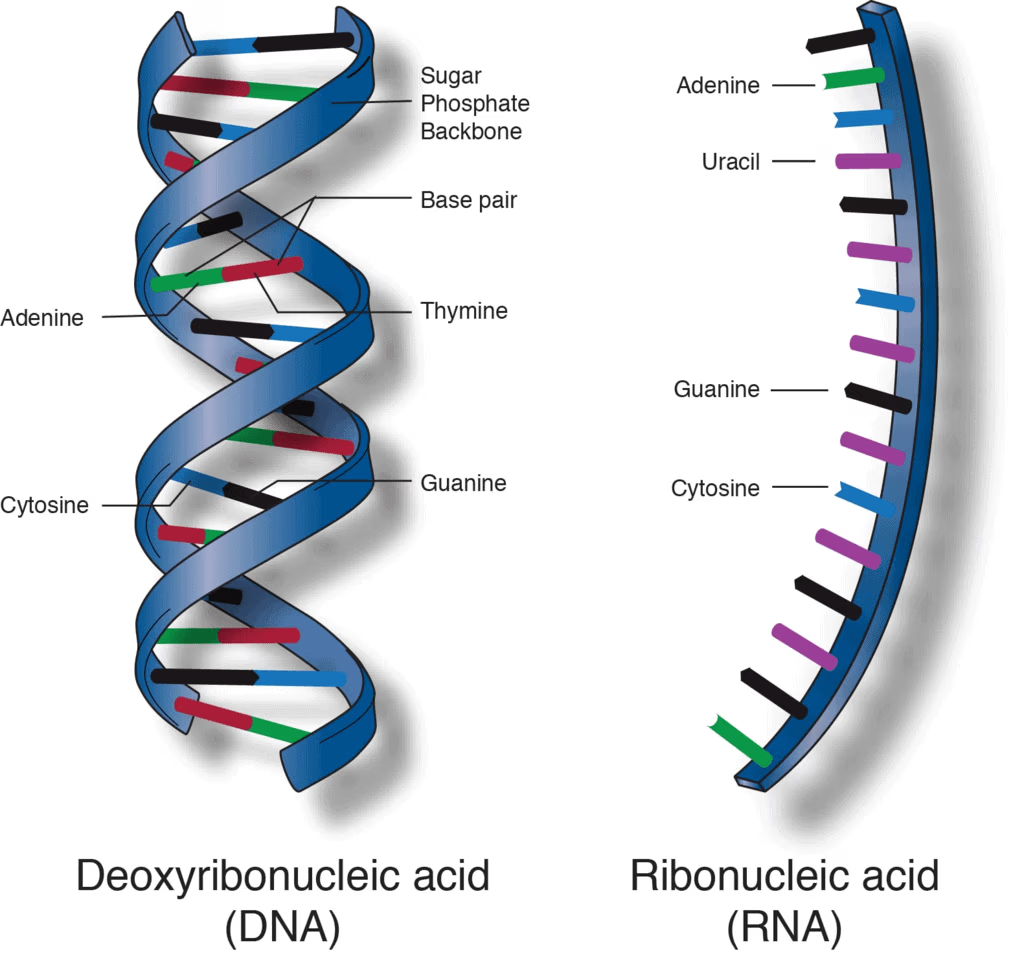
Der Begriff „Polynucleotid“ ruft Assoziationen zu mRNA und Genregulation hervor – hochintelligente molekulare Steuerungseinheiten des Lebens.
Tatsächlich aber sind die in Schönheits-Injektionen verwendeten DNA-Fragmente aus Fischzellen völlig informationslos.
Sie transportieren keine genetische Botschaft, codieren kein Protein und regulieren keine Genexpression in menschlichen Zellen (Samizadeh, 2023).
Was sie tun, ist deutlich banaler – aber nicht zwingend weniger wirksam: Sie binden Wasser, wirken antioxidativ & provozieren eine Art kontrollierte Irritation des Hautgewebes, die Fibroblasten stimuliert (Cavallini et al., 2020).
Mit anderen Worten: Die Haut wird gereizt – und antwortet mit Reparaturmechanismen.
Die Galenik: Biotech oder Biokosmetik?
Die Injektionspräparate sind meist einfach zusammengesetzt. Kein Vergleich zur gezielten mRNA-Abgabe in der Impfstoff-Technologie.
Weder Lipidnanopartikel noch intelligente Trägersysteme kommen hier zum Einsatz.
Der „Schutz“ der Fisch-DNA besteht aus hoher Viskosität & Reinigung – nicht aus molekularer Raffinesse (Palmieri & Cavallini, 2024).
Es geht nicht um molekulare Präzision, sondern um mechanische Biostimulation.
Und genau darin liegt das Risiko: Was als „sanfte Biorevitalisierung“ verkauft wird, ist in Wahrheit ein unspezifischer biologischer Reiz – oft ohne fundierte Langzeitstudien.
Die Haut ist kein Spielplatz
Die Haut ist das größte Organ des Menschen. Sie schützt, atmet, reguliert, signalisiert.
Wer in sie hineinspritzt – sei es mit Fillern, Toxinen oder Fisch-DNA – trägt Verantwortung.
Eine Verantwortung, die über oberflächliche Kosmetik hinausgeht.
Was heute als Innovation vermarktet wird, kann morgen als übergriffige Intervention erscheinen.
Polynucleotide aus Lachs-Sperma sind kein Unsinn. Sie wirken – irgendwie.
Aber sie sind auch kein Wunderstoff, sondern Teil eines Systems kosmetischer Reiztherapien, die mehr dem Markt als der Molekularbiologie verdanken.
Schönheit mit Verstand – nicht mit Versprechen
Zwischen den Zeilen der Studien spricht nicht die genetische Intelligenz des Lachses, sondern die Suggestion eines Marktes, der Biotechnologie als Verkaufsargument nutzt.
Wer ernsthaft ästhetisch arbeiten will, muss die Haut nicht nur verschönern, sondern verstehen.
Und das heißt: Ihre Biologie respektieren – und ihre Würde wahren.
Literaturauswahl:
- (Lee et al., 2024) – Übersicht zu Anwendung und Effektivität von PN
- (Cavallini et al., 2020) – Konsenspapier zu PN-HPT™ Anwendungen
- (Samizadeh, 2023) – Kritische Analyse zu biochemischer und ethischer Bedeutung
- (Palmieri & Cavallini, 2024) – Praxisleitlinien zur PN-Priming-Behandlung
- (Kuan et al., 2019) – Antioxidative Wirkung von Lachs-DNA in vitro
Polynucleotides from Salmon Sperm: Beauty via Fish DNA – Regeneration or Molecular Placebo?
From molecular biology to aesthetic medicine – a critical perspective
The New Hope of Aesthetic Medicine
They go by names like “PN-HPT™,” “Rejuran®,” or simply “Salmon DNA.” The latest trend in aesthetic medicine promises natural regeneration through polynucleotides—often extracted from salmon sperm. What may sound like a quirky marketing stunt has already become standard practice in many clinics. But is this truly a biotech breakthrough—or just another chapter in the long history of cosmetic fads?
DNA Does Not Equal Genetic Instruction
The word “polynucleotide” evokes associations with mRNA and gene regulation—intelligent molecular tools central to life. In reality, however, the DNA fragments used in cosmetic injections are non-functional: they carry no genetic code, produce no proteins, and regulate nothing in human cells (Samizadeh, 2023).
What they do is far simpler—though not necessarily ineffective: they bind water, act as antioxidants, and provoke a controlled irritation of the tissue that triggers fibroblast activity (Cavallini et al., 2020).
Galenics: Biotech or Biocosmetics?
injectable products are typically not highly sophisticated. Unlike the precise delivery systems of mRNA vaccines, they do not use lipid nanoparticles or intelligent carriers. Their “protection” relies on viscosity and purification, not molecular targeting (Palmieri & Cavallini, 2024).
This is not molecular precision—it’s mechanical biostimulation. And therein lies the risk: what is marketed as gentle biorevitalization is, in fact, an unspecific biological trigger, often without robust long-term data.
The Skin Is Not a Playground
The skin is the body’s largest organ. It protects, breathes, regulates, and senses. Injecting into it—whether with fillers, toxins, or fish DNA—is an intervention that carries responsibility. A responsibility that goes beyond superficial beauty.
Polynucleotides from salmon sperm are not nonsense. They do something. But they are also not a miracle ingredient. They are part of a cosmetic trend toward stimulus-based therapies—driven more by marketing than molecular science.
Bottom Line: Beauty With Understanding—Not Hype
Between the lines of the studies, it’s not the intelligence of salmon genetics speaking—it’s the marketing of biotech as branding. Anyone who practices aesthetic medicine seriously must do more than make skin look good—they must understand how it functions. That means respecting its biology—and preserving its integrity.



Dr. Hans-Ulrich Jabs, MD, PhD, MACP-ASIM,
Facharzt für Innere Medizin, Geriatrie & Biochemiker,
American College of Physicians – American Society of Internal Medicine
KZAR – Kompetenzzentrum Autonome Regulationsmedizin
©2025, Dr. HU Jabs
